In our Polar and Alpine Community News we feature news from the many partners that APECS is working with, as well as other news from a variety of sources related to research in the Arctic, Antarctic and Alpine regions as well as the wider Cryosphere. Many thanks to APECS members and the wider Polar research community for contributing to this shared resources!
If you want to submit Polar or Alpine News for this page, please use the link below. If you have any questions, This email address is being protected from spambots. You need JavaScript enabled to view it..
We keep only the news of the last 3 months on this page. Older news can be accessed in our Polar and Alpine News Archive.
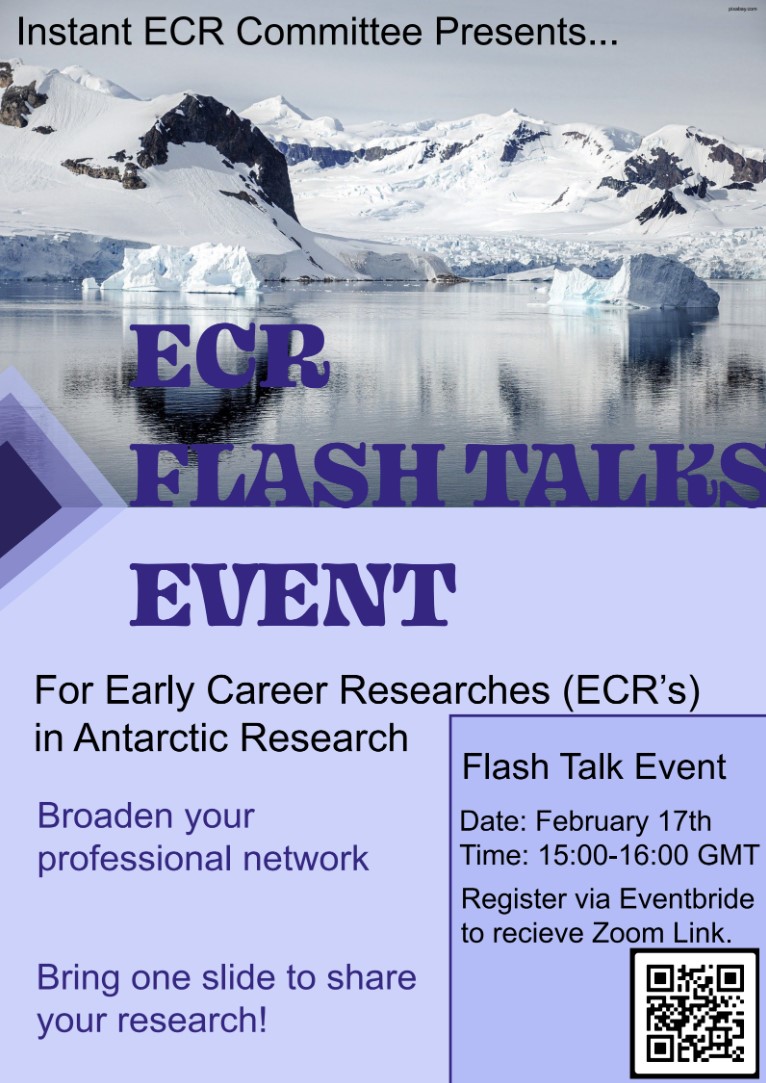
SCAR INSTANT Programme invites you to the onlineECR Flash Talks Event designed specifically for Early Career Researchers (ECRs) in Antarctic research. Whether your focus is on ice sheet dynamics, biology, atmospheric sciences, or social impacts of Antarctic research, this event is a great opportunity to share your research in a low-pressure and friendly setting. Either come along and share your research, or join the audience to find out what others are doing.
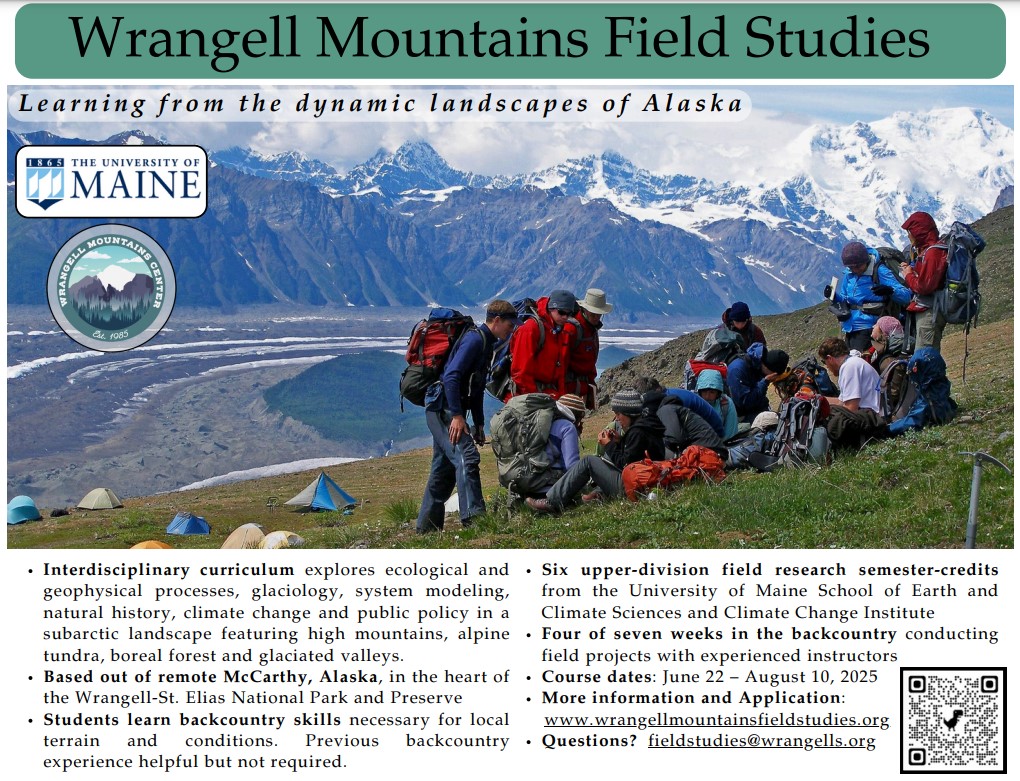
Applications are open for Wrangell Mountains Field Studies 2025.
Field Studies is an interdisciplinary field research program hosted by the Wrangell Mountains Center in McCarthy, Alaska, located in the center of Wrangell-St. Elias National Park and Preserve. The program is accredited through the University of Maine and offers six (6) semester-credits for Field Research Experience in Earth and Climate Sciences. Areas of focus include local geophysical processes (including glacier dynamics), ecology, system modeling, and land use/policy.
Interested students should apply via our application at https://wrangellmountainsfieldstudies.org/apply. Applications are reviewed on a rolling basis, so early submission is recommended. For questions please contact This email address is being protected from spambots. You need JavaScript enabled to view it.
The Arctic Youth Network (AYN) is excited to announce the recruitment of motivated and engaged youth aged 18 to 35 y.o. to join its current Board of Directors and people with extensive experience working in and with the Arctic to join an Advisory Board (no strict age limit). This recruitment aims to fill in 4 vacant positions in the Boards.
Every year, the European Union awards around 1,700 MSCA postdoctoral fellowships. These fund researchers to focus on the scientific puzzles they are most passionate about, full-time for up to three years.
MSCA funding is highly competitive. During the 2023-24 round, less than 16% of applications were successful. In contrast, all three applicants who applied through iC3 received funding – a perfect 100% success rate.
Building on this success, the iC3 Polar Research Hub is launching its own, in-house support programme for strong MSCA candidates.
We will actively support each selected applicant on a 1:1 basis, from the moment we take them on board until the day they submit their proposal.
This is an opportunity for you to help to shape the science and structure of a new SCAR biological research programme.
The aim of the new SCAR scientific programme concentrating on all areas of biology and ecology, Changes in Circumpolar Antarctic Gradients in Ecosystems (C-CAGE), is to use the natural environmental gradients in temperature, ice cover, and other physical drivers that exist in different parts of Antarctica and the sub-Antarctic (with latitude, longitude, altitude, and depth) to better predict the likely outcomes for life as the region’s habitats change.
C-CAGE is at the programme planning group stage and looking for input from the scientific community and they need your helpto establish who is interested in being part of C-CAGE and what it should be focusing on. They ask you to fill out a short survey (less than 10 minutes of your time) to help them narrow down these big themes and questions to those that are relevant to current and future work by the SCAR biological research community: https://forms.office.com/e/345VHHwT0Z
They would greatly value as many responses as possible before the end of March 2025 and would appreciate it if you would share this message with any relevant colleagues who might be interested. They encourage researchers of all career stages, backgrounds, nationalities, and areas of interest to contribute and ensure that their science is represented.
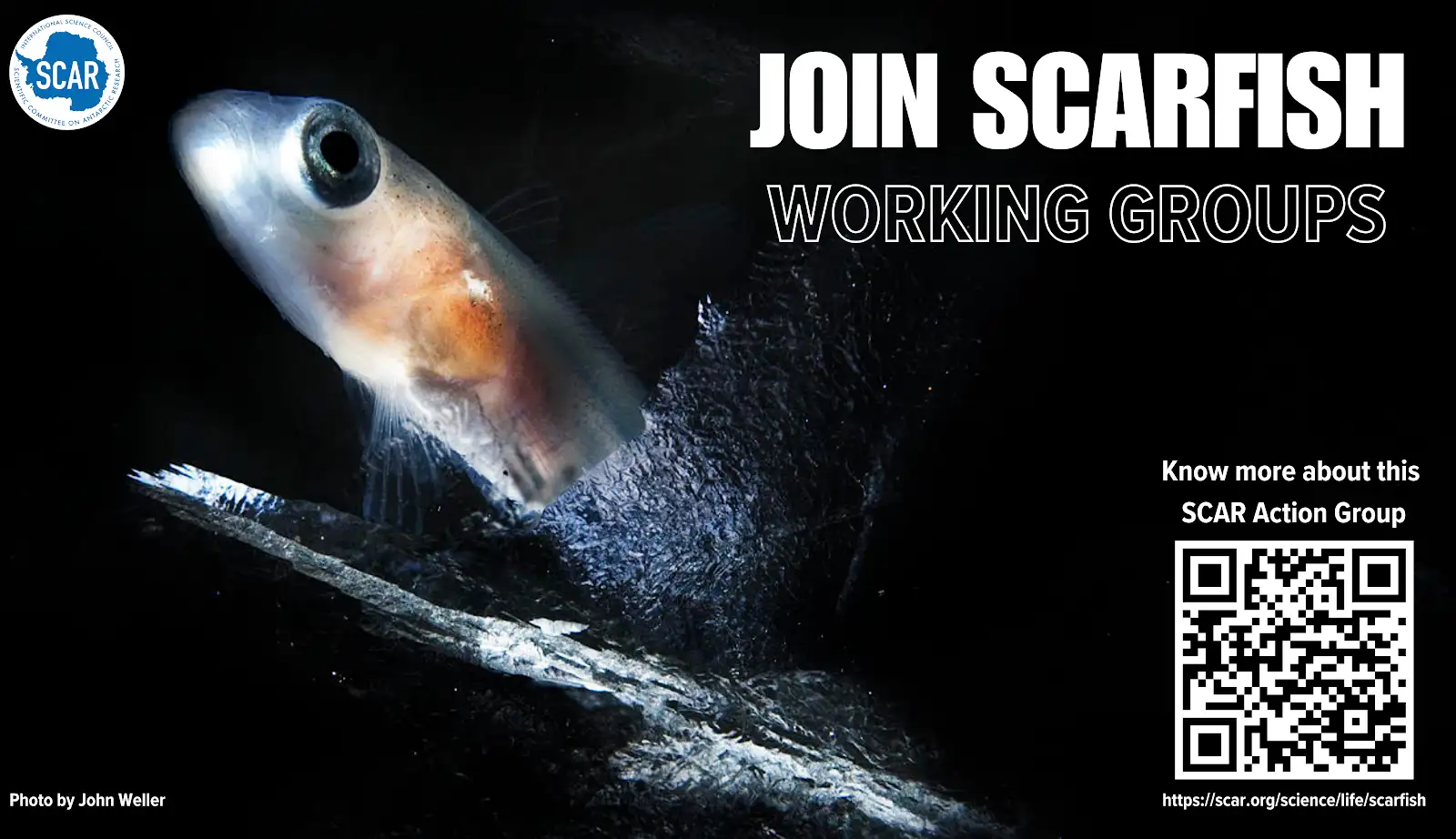
SCARFISH is a newly formed action group from the Scientific Committee on Antarctic Research (SCAR) under the Life Sciences Group that aims to identify research gaps in fish biology and foster broader international collaboration and coordination to fill those gaps; synthesize fish research needs from the Commission for the Conservation of Antarctic Marine Living Resources (CCAMLR) and work to integrate more comprehensive Southern Ocean fish research into CCAMLR; while increasing diversity in the Southern Ocean fish research community, including increasing the engagement of Early Career Researchers (ECRs) in this research topic.
SCARFISH is launching its Working groups and aims to engage ECRs in its activities, from co-leadership positions to working group members, that will be working alongside other ECRs and established scientists to achieve SCARFISH goals. If you are involved in Antarctic fish research and would like to participate in SCARFISH Working groups, please fill out this form.
This e-Journal is being curated by a volunteer team of Arctic scholars as a supplement to the fourth International Conference on Arctic Research Planning (ICARP IV) process and as a complement to the International Arctic Science Committee (IASC)’s annual report on Arctic research. As a Research Priority Team 5 (RPT 5) for IASC, we seek to address areas in Arctic research of Indigenous-led methodologies and co-production of knowledge. We intend to fill the research gaps and prioritize these topics across the global Arctic and publish a new e-Journal each year leading up to the next International Polar Year IPY (2032-2033). Leading up to the IPY, we envision this as the first Indigenous Polar Year that uplifts and carries the voices of the Arctic through effective and respectful community engagement and research. We aim to present this first e-Journal during the ICARP IV Summit / ASSW 2025 in Boulder, Colorado, USA (21 – 28 March 2025) as part of the supporting materials for the ICARP IV process for RPT 5.
Indigenous Peoples of the Arctic carry a wealth of generational knowledge essential for understanding the Arctic's environment and interconnectedness with socio-economic systems. Advancing non-Indigenous Arctic research forward requires collaborative efforts guided by Indigenous Knowledge holders, with knowledge co-production at the core. This approach requires ethical and equitable engagement, alongside recognition of Indigenous sovereignty.
This inaugural issue discusses Indigenous-led methodologies and how/whether knowledge can be co-produced by two or more individuals/groups with different knowledge systems, experiences, and methods for generating, sharing, and using knowledge. We invite submissions focused on Indigenous ways of knowing and research methodologies that focus on Arctic Peoples from a community perspective.
In this issue, we invite scholars to share their research experiences that support, highlight and uplift Arctic voices centred on Indigenous-led methodologies and sustainable co-production of knowledge within Arctic research contexts. It is our intention to highlight respectful, relevant and relational research practices. We encourage critiques of knowledge co-production and also recommend that knowledge co-production is defined and operationalized in submissions.
Based on feedback from Indigenous scholars and practitioners, we will not strictly adhere to the requirements of our ‘article types’ for processing submissions. It is acknowledged that knowledge is defined in different ways and that Western formats do not lend themselves well to such diverse ways of knowing. We encourage the submission of stories/poetry/photography/artwork that illustrate successes and challenges as well as provide practical or theoretical insights into engaging with Indigenous and co-produced methodologies.
Submissions must meet the following criteria:
Academic articles, story work, and poetry: Word or RTF Format only (no PDF)
Art and images must be high quality (300 dpi) TIFF, BMP or JPG, please accompany a brief summary or story with images (300-word count minimum).
Images must be your own works.
Articles and stories must be no more than 3000 words. We encourage shorter easy-to-read pieces (between 500 and 1500 words).
All submissions must be submitted by the due date for consideration in the upcoming issue.
Authors should submit a piece that is as close to print-ready as possible.
Submissions should not have been previously published.
We recommend all submissions involving Indigenous communities consider Gregory Younging’s Elements of Indigenous Style: A guide for writing by and about Indigenous people.
The abstract deadline for submissions to the Calling on Wisdom Keepers: The Gifts of the Arctic is December 30th 2024. Submissions will be peer-reviewed, and acceptances will be announced in and Authors will be notified by January 2024 if accepted)
Full submissions are due on February 15, 2024. The inaugural Indigenous-led methodologies and knowledge co-production e-Journal special issue will be published in 2025 following feedback during the Arctic Science Summit Week 2025, Boulder, Colorado.
This issue editorial team consists of: Anita Lafferty (University of Alberta), Stacey Lucason (Kawerak, Inc.); Norma Shorty (Yukon University); Louise Mercer (Northumbria University); Chelsea Koch (American University); Amanda Young (University of Alaska Fairbanks).
If you would like to contribute to the work of the editorial team, please indicate your interest through this form.
The Swedish Polar Research Secretariat invites Early Career Scientists to take part in a research program on a joint expedition with the Swedish Icebreaker Oden and the Canadian Icebreaker CCGS Louis S. St-Laurent 9 August – 19 September 2025.
The Early Career Scientists program will be running in parallel to the Canadian activities on board. The program consists of the course "The Arctic Ocean Climate System" with a study load of 10 ECTS. The course combines practical work with observations and measurements in defined work packages with a curriculum of lectures covering the coupled Arctic climate system, and it will also allow for the enhancement of the participant's own research projects. As an Early Career Scientist (ECS), you will participate in the data acquisition and ideally use the collected material and data in your research.
EU-PolarNet 2, a H2020 - Coordination and Support Action funded project, has launched an open access Stakeholder Engagement Portal.
The portal supports researchers in deciding which stakeholders and/or rights holders they should involve in the planning and implementation of research in the polar regions and in conducting a two-way dialogue. It is designed to be used for either Arctic or Antarctic. It provides guidelines by linking to existing resources for identifying, determining the role of stake- and rights holders, dialogue, resources and opportunities, support and continuing cooperation.
The portal aims to share information and support the decisions of projects and researchers themselves.
Join an impactful online discussion on Research Ethics in Indigenous Studies on November 21st! Dive into a conversation on how to promote respectful, inclusive, and collaborative research approaches that honour Indigenous knowledge, data sovereignty, and intellectual property rights. This event aims to guide early career researchers in ethical practices that build lasting, respectful partnerships with Indigenous communities.
Together, let’s foster a future of research that uplifts and respects Indigenous voices!
The event is co-organized by the Arctic Centre of the University of Groningen and the Arctic Youth Network Indigenous Peoples Working Group.



 The event is co-organized by the Arctic Centre of the University of Groningen and the Arctic Youth Network Indigenous Peoples Working Group.
 Speakers TBA